Saturday, 24 May 2014

May catch up

I've seen a few bits and bobs over the past couple of weeks, so I thought I'd stick in a post with some photos that I've managed to take. The best place over the past few weeks has been Rush Hills Scrape. Although I've still not seen the Glossy Ibis that appears to be roosting in the area, there's been plenty of other birds to see. The pick of the crop is a Temminck's Stint that I had on 10 May. There were about 80 each of Dunlin and Ringed Plover around that day too, so plenty to see. The scrape still looks really good for waders and there's been a good selection of waders there every day I've been.

Temminck's Stint (middle) with Ringed Plover (back) and Dunlin (foreground), Rush Hills Scrape, Norfolk.

Garganey has also been a regular visitor to the scrape, with a male being seen regularly over the past couple of weeks. I had a pleasant surprise today though as there were 2 drakes hanging around together. Other birds on Rush Hills over the past couple of weeks include Wood Sandpiper, Green Sand, Common Sand, Grey Plovers, Greenshanks, Whimbrel, Ruff, 4 Little Gulls, Med Gull and plenty of other commoner stuff.

2 drake Garganey, Rush Hills Scrape, Norfolk.

 The coast has been pretty quiet and hard going (spring always is). I did enjoy watching this Stonechat build its nest at Horsey Gap the other week though.
It's that time again! Female Stonechat, Horsey Gap, Norfolk.
Tawny Owl, Cley-next-the-Sea.

Linseed Field, Morston, Norfolk.

Friday, 18 April 2014

18 Apr 14 - Waxham

The strong northerly wind was a bit of a problem today. Although bright sunshine for much of the day, it was still very cold and difficult to see any migrants in the bushes. I walked from Horsey Gap to just beyond the pipe dump and did still manage a decent horde of birds though.The best was two male Ring Ouzels that flew over me as they made their way north along the dunes. The campsite had three male Northern Wheatears on it plus a really good count of 77 Linnets. Also, my first Common Whitethroat of the spring was having a good sing just north of the pipe dump. Back at the car, a couple of Whimbrel and a Hooded x Carrion Crow hybrid fed in the fields along the access road.

My first Common Whitethroat of the spring. Waxham, Norfolk.

17 Apr 14 - North Norfolk

I spent the day on the North Norfolk coast with Mark Golley. Our first stop was Titchwell RSPB. The first Sedge Warblers had arrived and there was a notable overhead passage of Yellow Wagtails (about 10 birds). A nice big buffy Greenland Wheatear fed with a Northern Wheatear near the dunes and 4 Velvet Scoters fed on the sea with some Common Scoters.
A couple of Sandwich Terns graced the freshmarsh, plus waders were quite numerous with a single Spotted Redshank, 20 Dunlin, 10 Red Knot, 200+ Bar-tailed Godwits and 50+ Black-tailed Godwits.
A pair of Red-crested Pochards showed very well in the main reedbed and a Bittern boomed for a minute or so.
Next we had a look at the east side of Holme. The idea was to try and find some grazing cows to see if there were any Yellow Wagtails with them, but we went one better and found a lovely confiding female Ring Ouzel. It fed in the open in a field next to the footpath and allowed us to get great views of it. A couple of Lesser Whitethroats were also nice to hear.

Female Ring Ouzel, Holme, Norfolk

Female Ring Ouzel, Holme, Norfolk

Female Ring Ouzel, Holme, Norfolk

Female Ring Ouzel, Holme, Norfolk

Female Ring Ouzel, Holme, Norfolk

Female Ring Ouzel, Holme, Norfolk

Female Ring Ouzel, Holme, Norfolk

Female Ring Ouzel, Holme, Norfolk


After trying and failing to find any Dotterel around Ringstead/Cholsey we headed off to Stiffkey Fen where a Common Swift was a really big surprise. I'm pretty sure that it was my earliest Common Swift ever in the UK. 8 Med Gulls, 150 Black-t Godwit, 5 Barn Swallows and about 10 Sand Martins also sheltered from the rain around the fen.

15 Apr 14 - Ouse Washes

As the Baikal Teal had reappeared in the Cambridgeshire, I thought I'd have a day around the Ouse Washes. I arrived at Four Balls Farm at about 8am. There was one other birder present, who'd seen the Green-winged Teal, but not a whole deal else. The site was really nice though, with lots of Yellow Wagtails, Little Egrets, Common Teal, Eurasian Wigeon, plus other waterfowl to look through plus lots of birds tucked up, roosting on the reed-covered banks that we could barely see. A few other birders arrived about an hour later and it was one of those who exclaimed that he was sure he'd just glimpsed one or two Glossy Ibis drop into the marsh. After a few minutes of watching, I noticed two dark shapes making their way along the channel at the back of the marsh. Glossy Ibises! I watched them on and off for about 10 minutes, looking back down the channel where all of the ducks had been congregating. At one point I caught a two-second view of a duck swim into some reeds which I felt sure was the Baikal and sure enough, 15 minutes later it swam out of exactly the same spot. It spent the next half-hour commuting between the two banks of the channel until I headed off at 10.30.
I had a look a bit further down the B1411 near the railway crossing, which is part of the Ouse Washes reserve. There was a lingering Whooper Swan on the marshes along with the Mute Swans, but not a whole lot else.
I had a stop at Lynford Arboretum on the way back in the hope of seeing some Two-barred Crossbills, but although there were plenty of Common Crossbills around (about 25), I couldn't find any with white wing-bars. The crossbills are much harder to see now. In the autumn and early winter, they were feeding on the pine cones on the outside of the canopies, but now those have mainly been eaten and the birds have to feed inside the canopies making them much harder to get on to.
With all these Two-barred Crossbills around, it does make me wonder if the UK will get its first breeding records this year.

14 Apr 14 - Waxham

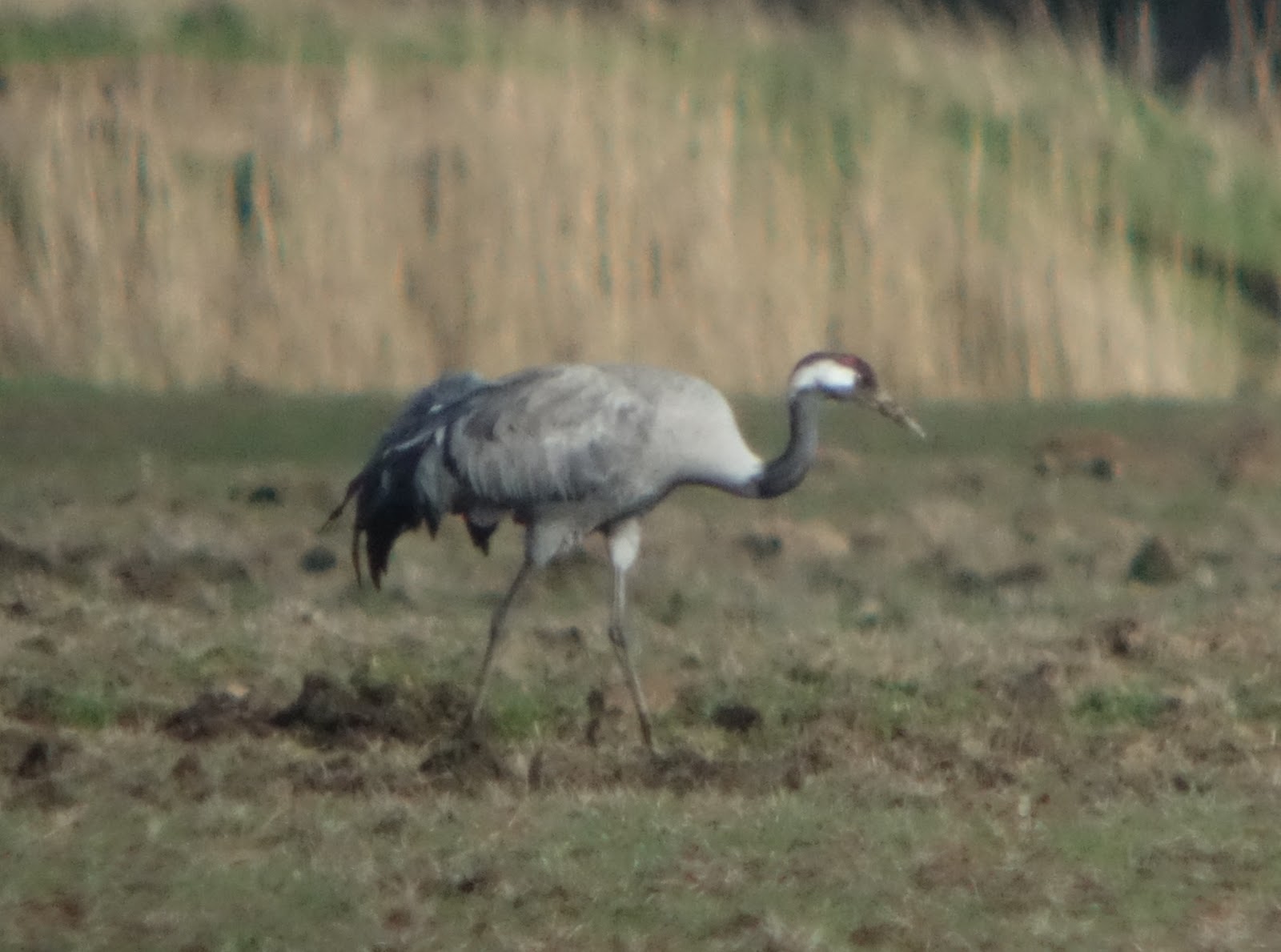
It was off to Waxham this morning. A pretty brisk wind made the birding quite tricky, but I did manage my first (!) Wheatear of the year, plus my first Lesser Whitethroat. A rather obliging Common Crane posed nicely for photos next to the road at Horsey and a trip down to Filby, Ormesby and Rollesby Broads produced a nice adult Little Gull and quite good numbers of Tufted Duck and Pochard.

Common Crane, Horsey, Norfolk

Common Crane, Horsey, Norfolk

Common Crane, Horsey, Norfolk

Common Crane, Horsey, Norfolk

13 Apr 14 - Bad decision Sunday

Bad decision - we all make them, but I made quite a few today. My first mistake was not to set my alarm in order to get up in time to reach Flanborough Head for dawn. If I'd arrived at 6.30 instead of 7.00, I'd probably have some half-decent photos of Crag Martin. OK, so the bird was still about. No problem, I'll go to the lighthouse as that's where it was it was seen heading off to. So I arrived at the lighthouse and stared scanning. After about 10 minutes the pager informed me (incorrectly as it turned out) that the Crag Martin was actually north of North Landing at Thornwick, so I dashed off there only for the martin to cruise past the lighthouse 5 minutes later never to be seen again. Despite scouring the headland for another 6 hours, it was obvious that it had departed. My first House Martin for the year, 20 Sand Martins and a few Barn Swallows were scant reward.

Bempton Cliffs was quite nice and afforded some good photo opportunities. It's always nice to see so many Tree Sparrows in the UK and the feeders around the visitors centre provide plenty of good views of this now rather scarce species. From the cliffs, there were about 8 Puffins on the sea plus plenty of Guillemots, Razorbills, Gannets and Kittiwakes around.

Tree Sparrow, Bempton Cliffs RSPB, N. Yorks


Tree Sparrow, Bempton Cliffs RSPB, N. Yorks
Gannet, Bempton Cliffs RSPB, N. Yorks

Gannet, Bempton Cliffs RSPB, N. Yorks

Gannet, Bempton Cliffs RSPB, N. Yorks


Gannet, Bempton Cliffs RSPB, N. Yorks


Gannet, Bempton Cliffs RSPB, N. Yorks

Gannet, Bempton Cliffs RSPB, N. Yorks
Kittiwake, Bempton Cliffs RSPB, N. Yorks

Saturday, 22 February 2014

North Norfolk

Made my fist visit of the winter to north Norfolk today (I know, it's almost spring!). It was a lovely sunny winters day, with temperatures pushing double figures. I started off at Titchwell RSPB, where a couple of Water Pipits and some nice photos of Brent Geese were had. The best birds though were on the sea. When I reached the beach I headed over to some birders using the largest dunes as cover and the told me they'd had 18 Velvet Scoter, all of which were shifting west in small flocks along with the Common Scoter. I joined in their count and within about 30 minutes the count had reached 39. This included seven birds that were sat just offshore, feeding with some Common Scoter. I don't know what the record count of Velvet Scoter is in Norfolk, but I'd imagine this might be close, especially over the past couple of decades.

It was then off to Stiffkey Fen to look for divers in Blakeney Harbour. Unfortunately, one of the seal boats had been through the harbour 15 minutes before I arrived and had pushed most of the divers up a channel, which wasn't visible from the coastal path. After about 30 minutes though, some of the divers emerged, with around 6+ Great Northerns and a Long-tailed Duck moving back out into the pit.
As well as the divers, there was a nice adult Black Brant, a Black Brant x Dark-belled Brent hybrid, a few Water Pipits flying around, Yellow-legged Gull and quite a few Med Gulls.

Drake Gadwall, Titchwell

Dark-belled Brent Goose, Titchwell

Dark-belled Brent Goose, Titchwell

Dark-belled Brent Goose, Titchwell

Dark-belled Brent Goose, Titchwell

Dark-belled Brent Goose, Titchwell
Hybrid Black Brant x Dark-bellied Brent Goose, Stiffkey


Hybrid Black Brant x Dark-bellied Brent Goose, Stiffkey

Hybrid Black Brant x Dark-bellied Brent Goose, Stiffkey

Hybrid Black Brant x Dark-bellied Brent Goose, Stiffkey
Adult Black Brant, Stiffkey

Adult Black Brant, Stiffkey

Adult Black Brant, Stiffkey

Adult Black Brant, Stiffkey

Adult Black Brant, Stiffkey

Sunday, 16 February 2014

Quck venture out

So it's finally stopped raining and the wind has died down enough below hurricane-force that I feel it safe to venture out into the field. In fact the sun was actually shining! So, I headed out to east Norfolk to have a mooch around Martham and Horsey to see what was around. Martham Broad was pretty quite, with about 30 Tufted Duck, 20 Gadwall and a Eurasian Wigeon being the only thing of note there. Four Common Cranes (2 pairs) were feeding in the fields just east of the coast road between Somerton and Horsey and the Black-throated Diver was swimming around in the middle of Horsey Mere. There's no access to Horsey Mill and hence the footpath past it to go around the south side of the boat mooring, so you need to head around the north side of the broad to view it. The bird was viewable after about 200 metres walk from the car park.

Finally, I did a late afternoon visit to see the Glossy Ibis by the river at the end of Cess Rd. The bird is very approachable and poses quite nicely for photos.